Criminal Defense Local SEO: How to Rank Top 3 on Google Maps (Proven Strategies)
When someone gets arrested, they don't browse law firm websites. They grab their phone and search for a criminal defense lawyer right now.
Google Maps is where that search ends, and where your phone rings or doesn't.
The top 3 results in the local pack capture the majority of clicks. Position 4 might as well be invisible. And in criminal defense, where urgency is everything and cases are worth thousands, losing that visibility has a direct dollar cost.
This isn't a traffic play. It's a revenue play.
In this post, I’ll break down the exact system our criminal defense local SEO agency uses to consistently generate top-3 map rankings. Often in as little as 2–3 months.
Why Google Maps Rankings Matter for Criminal Defense Lawyers
Most legal SEO advice focuses on organic rankings. But criminal defense is different.
When someone needs a defense attorney, they need one now. They're not reading blog posts or comparing firms over a few days. They're in crisis mode. They want a phone number, reviews, and a location — fast.
That's exactly what Google Maps delivers.
"Near me" searches dominate criminal defense queries. Most people searching for a criminal defense lawyer on their phone never usually scroll past the local pack. They call the first firm that looks credible.
Maps leads are hotter than any other source. These aren't blog readers or newsletter subscribers. They're people who just got arrested — or someone they love just did. That's the highest-intent lead you can get. No nurturing required.
Mobile behavior favors Maps. The overwhelming majority of local legal searches happen on mobile. Google Maps is built for that experience. It surfaces your reviews, your hours, and your phone number above everything else.
The local pack controls click share. Studies consistently show that the 3-pack captures a disproportionate share of local search clicks. If you're not in it, you're splitting scraps with everyone else on the page.
What this means in practice: A criminal defense firm that dominates the local pack in their city gets a consistent stream of high-intent calls… people ready to hire. A firm stuck below the fold competes on price, because they're only reached by clients who are already shopping around.
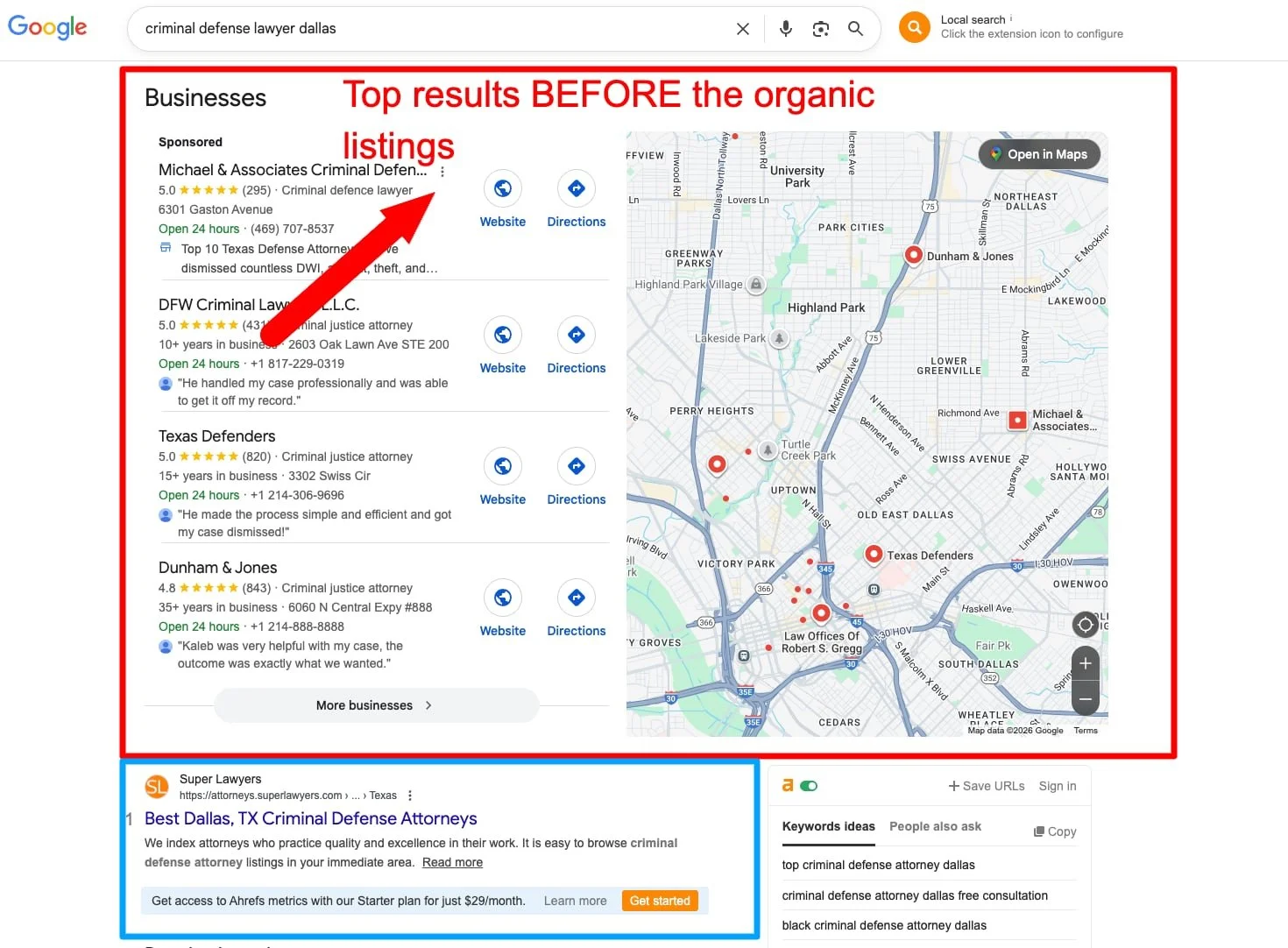
These days, the maps pack takes up SO much search real estate that you need to be in it. Otherwise your visibility will suffer dramatically.
How Google Ranks Criminal Defense Law Firms Locally
Google uses three core signals to determine local pack rankings. Understanding all three is the difference between guessing and winning.
Relevance
Google needs to know exactly what you do, and who you do it for.
That means your Google Business Profile (GBP) must be category-specific (Criminal Defense Lawyer, not just "Attorney"), your services must be listed clearly, and the language you use across your profile and website should match the way clients actually search.
Generic practice areas hurt you. Specificity wins. A firm that clearly signals "DWI defense in Frisco, Texas" will outrank a firm that vaguely lists "criminal law" with no geographic targeting.
Distance
Google factors in physical proximity between your office and the person searching.
You can't move your office, but you can build location-specific pages and a content strategy that extends your relevance into surrounding cities and counties. More on that below.
Prominence
This is where most of the ranking leverage lives, and where most firms fall short.
Prominence includes: the number and quality of your Google reviews, citations across legal directories, backlinks to your website, and how authoritative your overall web presence looks.
The firms dominating the Maps pack in competitive markets aren't just optimized, they're actively building prominence every month.
Step-by-Step: How to Rank Top 3 on Google Maps
This is the system we've used to move criminal defense firms from invisible to dominant in the Maps pack. Not generic "optimize your GBP" advice — the actual architecture that drives results.
Step 1: Link Your GBP to the Right Page
Most multi-practice firms make this mistake immediately: they link their Google Business Profile to their homepage.
Don't.
Your GBP should link to a dedicated landing page that matches exactly what you do and where you do it.
If your profile is targeting "Criminal Defense Lawyer Arlington," the linked page should be a location-specific criminal defense landing page — not your homepage, not your about page, not a general legal services page.
This page becomes the hub for everything that follows.
Google uses it to validate that you are who you say you are and that you serve the area you're claiming.
Why this matters: Google is trying to match searchers with the most relevant, location-specific result. If your GBP links to a homepage that covers family law, estate planning, and personal injury, you're diluting your relevance signal. A tight, focused landing page tells Google exactly what you offer and where.
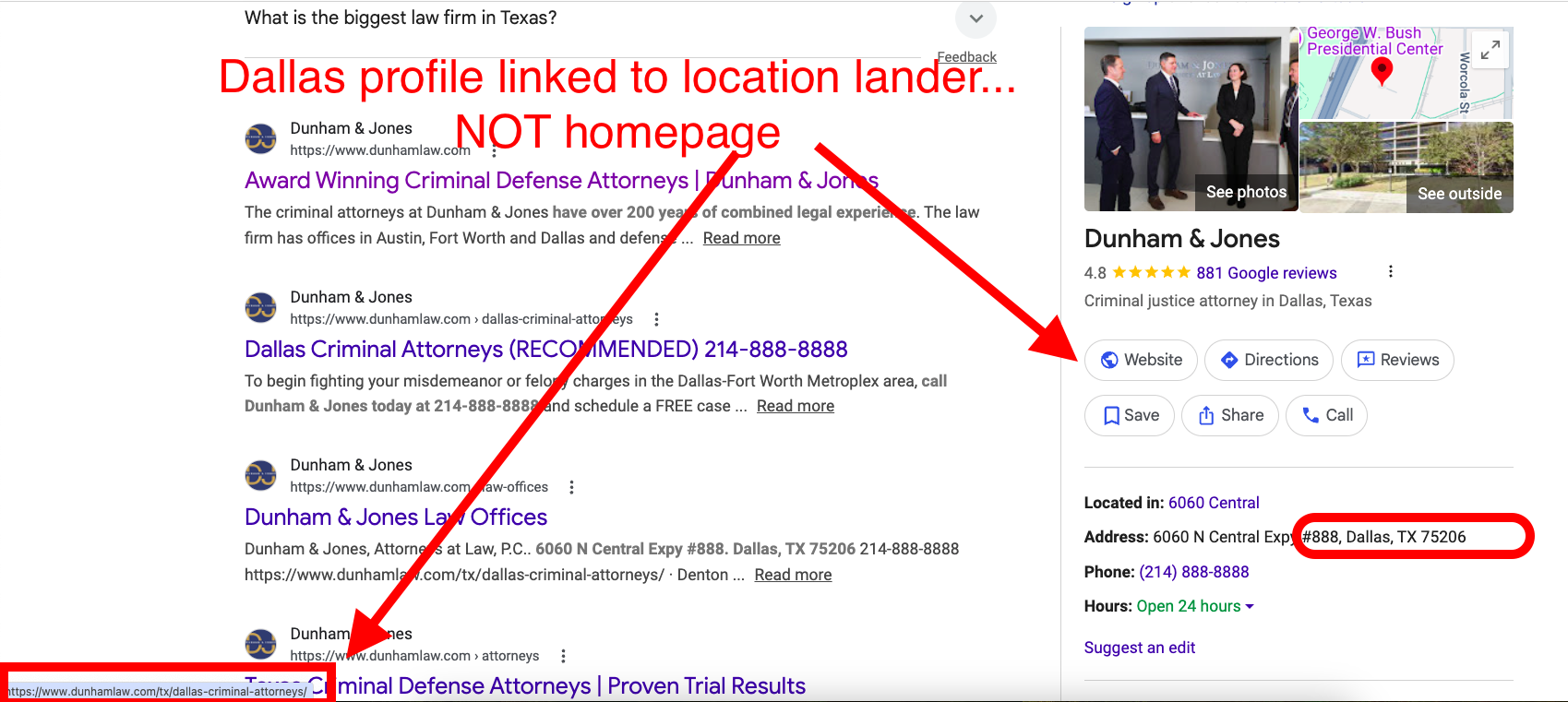
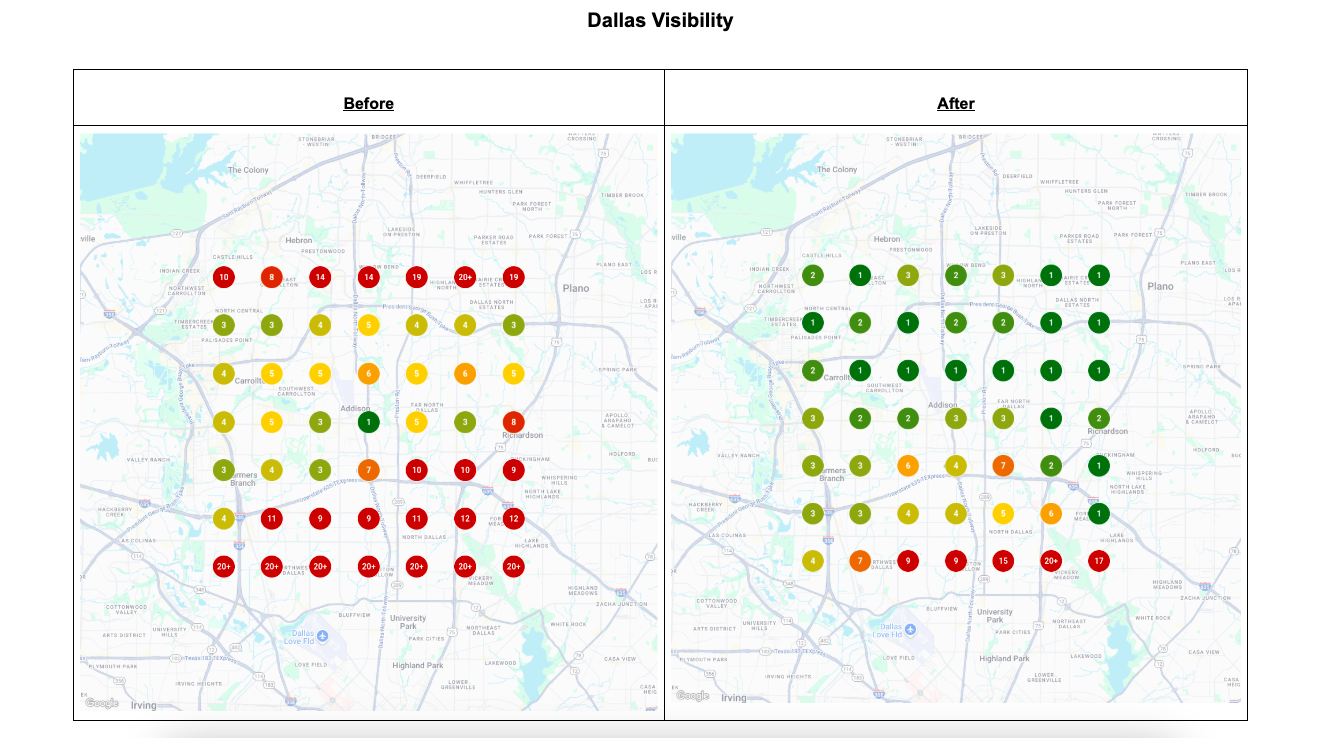
This firm is multi-location. They have successfully linked their Dallas GMB to a Dallas specific landing page to benefit for better local signalling.
Step 2: Build Depth Behind the Hub Page
This is the highest-leverage step — and the one almost no one does correctly.
Your hub landing page needs to do more than introduce your firm. It needs to demonstrate comprehensive expertise in criminal defense for that specific location.
Here's the structure that works:
Every service you list on your GBP needs a dedicated section on your hub page. Not a bullet point. A 100-word written description of that specific service type. DWI, assault, drug possession, probation revocation, manslaughter — every service gets its own section.
This signals to Google that you're a comprehensive resource, not a generalist. Your competitors are listing two or three services. You're showing Google every case type you handle. That depth of coverage is a trust signal.
Each service section links to a dedicated child page. That child page covers that specific practice area in depth — and it links back to the hub page.
This parent-to-child page structure creates a web of internal authority that reinforces your relevance for every search variation. Someone searching "assault lawyer Arlington" hits the child page. Someone searching "criminal defense lawyer Arlington" hits the hub. Both paths lead Google back to the same core location profile.
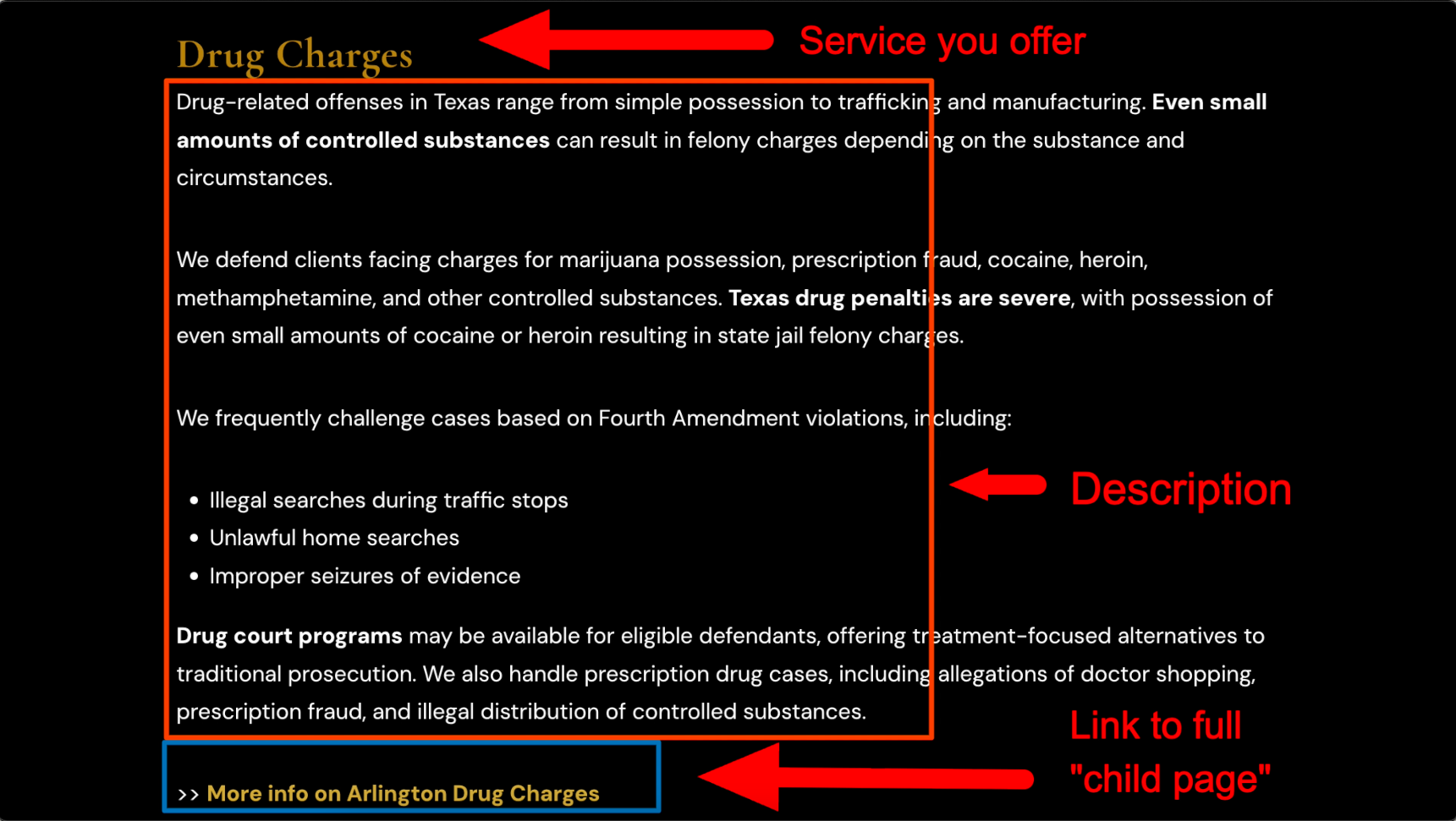
Parent, child page SEO structure for Criminal Defense
What this means in practice: If you have 20 services and 10 locations, you're building 200+ pages. That sounds like a lot. But this is the depth that separates firms ranking in position 1 from firms stuck in position 8. Most agencies charge a premium for this kind of architecture — or they skip it entirely. The firms that do it win.
Want help building this structure for your firm?Talk to our criminal defense SEO team →
Step 3: Get More 5-Star Reviews — Systematically
Reviews aren't just a ranking factor. They're the deciding variable between two similarly-ranked firms.
But volume without a system is unreliable. You need a process that captures reviews from every closed case — not just the happy clients who happen to think of it.
Here's the system that works:
Every closed case triggers an automated SMS and email review request
The client's contact info drops into a tracking sheet
A rep follows up manually — by phone — with every single client
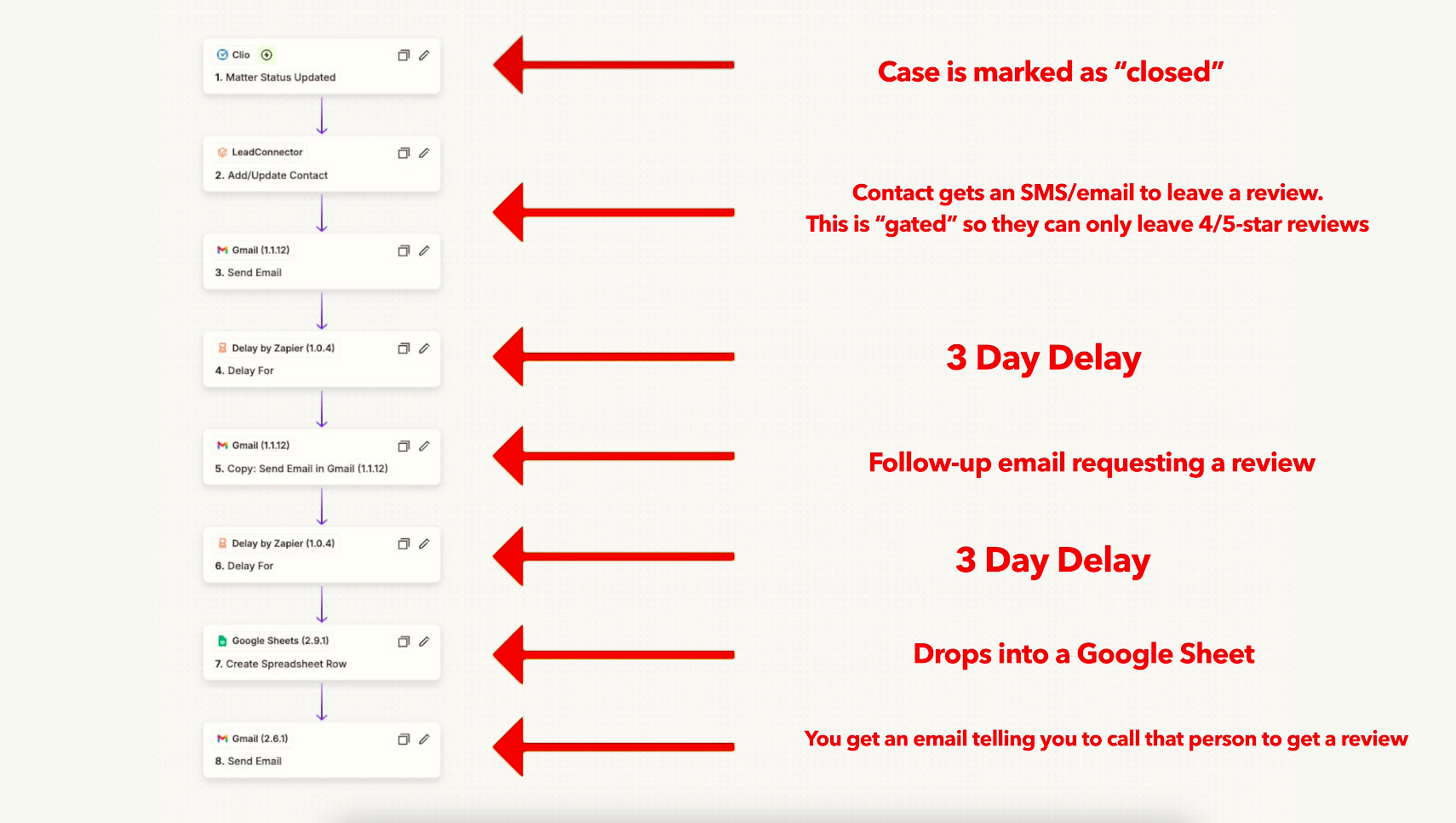
The automated review generation system we build for our clients.
The phone call is the key. SMS and email get decent response rates. But a real person calling to request the review and walking the client through it right then and there — that's what maximizes your capture rate.
The review link you send should route directly to the specific GBP you're trying to rank. If you're prioritizing your Arlington profile, every review request points there until it's competitive.
Where most firms go wrong: They ask for reviews inconsistently, only when they remember, only from cases where the client seemed happy. That's not a system. That's hoping. You need automation plus human follow-up, triggered by case closure — not by mood.
On responding to reviews: Respond to every one. Include location and practice area language naturally. "Thank you for trusting us with your DWI case in Frisco — we're glad we could help." This isn't keyword stuffing. It's relevant context that reinforces your local signals.
Step 4: Optimize Your Website for Local SEO
Your GBP and your website need to be aligned, not just linked.
Location pages for each service area you target. Practice area pages that go deep on specific case types. Schema markup that tells Google you're a law firm serving specific geographic areas.
NAP consistency matters. Your Name, Address, and Phone number must be identical across your website, your GBP, and every directory listing. Any inconsistency creates confusion for Google's local algorithm.
Step 5: Create Location-Based Content
Blog posts targeting specific cities, counties, and courts build local relevance over time.
"What to expect at the Tarrant County Criminal Court" is a more useful local signal than "criminal defense tips." It answers a real question for a real person in a real place.
This content also captures long-tail searches from people earlier in the urgency cycle — someone researching after a loved one's arrest, before they're ready to call.
Step 6: Build High-Quality Backlinks
Local prominence comes from external signals, not just internal structure.
Legal directories (Avvo, Justia, FindLaw, Martindale) are the baseline. Local press coverage, community sponsorships, and guest contributions to local news outlets build the kind of geographic authority that moves your Maps ranking.
Backlinks from non-legal local sources — a sponsorship of a local organization, a feature in a local business journal — often carry more weight than another generic legal directory listing, because they're harder to replicate.
How Our Criminal Defense Local SEO Services Help You Rank Faster
We built this system specifically for criminal defense firms — and we've replicated the results across multiple clients.
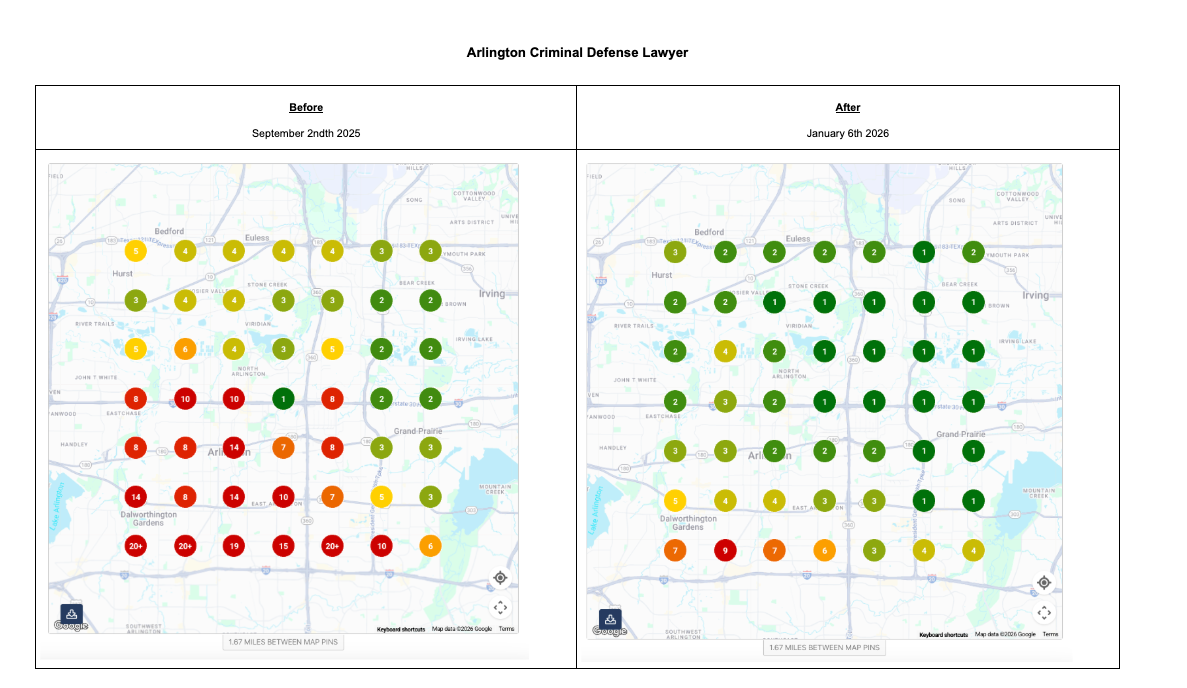
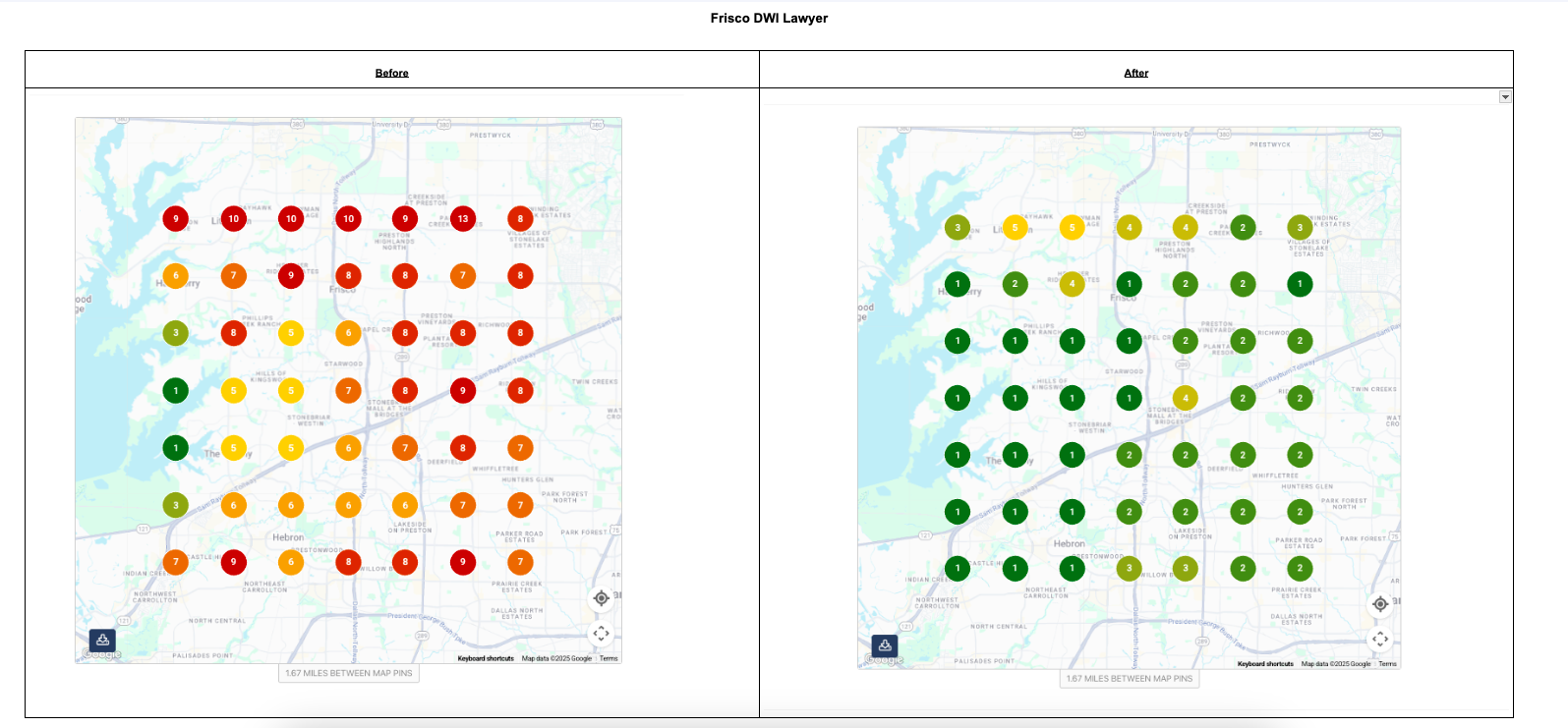
One firm we worked with served 16 locations across Texas. They were showing up nowhere near the top of the Maps pack in Frisco or Arlington. We restructured their location pages, built out their service page architecture, and directed consistent reviews to their target profiles.
Within 3 months in Arlington and 2 months in Frisco, they moved from red (positions 7–10) to green (positions 1–3) for high-intent searches like "DWI lawyer Frisco" and "criminal defense lawyer Arlington."
The result wasn't just better rankings. It was more urgent, high-intent calls — from people who had already decided they needed a lawyer and were ready to hire.
That's the difference between Maps traffic and any other source. These are your hottest leads. They found you at the exact moment of need.
Proven Results Before / After My System (3 month change)
Common Local SEO Mistakes Criminal Defense Lawyers Make
Ignoring Google reviews until you need them. Reviews are a compounding asset. Firms that build consistently over months have an insurmountable advantage over firms that try to catch up quickly.
Linking GBP to the homepage. This single mistake undermines your entire local relevance signal. Fix it first.
NAP inconsistency across listings. Even small differences — "St." vs. "Street," different phone number formats — create friction in Google's local algorithm.
Building no location-specific depth. A single city page with 300 words doesn't compete with a firm that has a hub page, 20 service sections, and 20 child pages all interlinking. Depth signals authority.
Treating the Maps pack like a set-and-forget channel. Firms that win consistently are actively adding reviews, publishing local content, and refining their profile every month. Not quarterly. Monthly.
Advanced Local SEO Strategies
Use Schema Markup for Law Firms
Schema markup tells Google exactly what your page is — a law firm, in a specific location, offering specific services. Without it, Google has to infer. With it, you've told them directly. Legal schema markup improves your chances of appearing in AI Overviews and featured results as well.
Optimize for Voice Search and "Near Me" Queries
"Criminal defense lawyer near me" and "DWI attorney open now" are high-intent, voice-driven queries. Your GBP needs complete hours, accurate location data, and mobile-optimized profile photos to capture these searchers.
Add Location Pages for Each Service Area
If you serve 10 cities, you need 10 location pages — each one with genuine local content, not just the city name swapped into a template. Google has seen the template play before. Thin location pages are a liability, not an asset. If you're also considering county-specific location pages, don't build them blindly. Learn when criminal defense lawyers should create county pages before investing the time, because not every county has enough search demand to justify its own page.
Track Rankings and Conversions Together
Rankings without revenue data are vanity metrics. Track where your signed cases are coming from. If your Maps ranking improves but call quality drops, something is misaligned — either the wrong searches are triggering your listing, or intake is leaking leads. Fix both.
Get More Criminal Defense Cases with Proven Local SEO
The Maps pack is where criminal defense cases are won and lost before a single intake call happens.
If your firm isn't in the top 3, you're not competing — you're watching other firms take calls that should be yours.
The system works. We've proven it across multiple markets, multiple firm sizes, and multiple practice area mixes. But it requires commitment to the full architecture: hub pages, service depth, review systems, and consistent local content.
If you're serious about growing your criminal defense firm through Maps visibility, let's talk about whether this is the right fit for you.
Book your free discovery call now…
Key Takeaways
Google Maps is the highest-intent channel in criminal defense marketing — leads arrive ready to hire, not just browsing
Link your GBP to a location-specific landing page, not your homepage — this is the most commonly missed setup error
Build a hub-and-child page structure: one core location page with 100-word service sections, each linking to a dedicated service page and back
Reviews need a system, not just a request — automated triggers plus manual phone follow-up captures the most reviews per closed case
Direct review links to the specific GBP profile you're trying to rank — concentrate authority rather than spreading it thin
Consistent monthly execution beats one-time optimization — the firms that win are actively building, not just set-and-forget
Realistic timeline: initial movement in 1–3 months, top-3 dominance in 6+ months for competitive markets
FAQ
How do criminal defense lawyers rank on Google Maps?
Ranking in the Maps pack requires three things working together: a fully optimized Google Business Profile linked to a location-specific landing page, a deep website structure that covers every service you offer in each location, and a consistent system for collecting high-quality reviews from closed cases. All three signals — relevance, prominence, and authority — need to be built simultaneously.
What is the most important ranking factor for local SEO?
Reviews and Google Business Profile optimization carry the most immediate weight. But the firms that sustain top-3 rankings long-term build depth on their website too — hub pages, service pages, and location pages that signal comprehensive local authority. Reviews get you into the pack. Website structure keeps you there.
How many reviews do I need to rank top 3?
It depends on your market. In smaller metro areas, 30–50 consistent reviews may be enough. In competitive markets like Dallas or Houston, top-3 firms often have 100+ reviews — with a steady stream of new ones coming in monthly. The cadence matters as much as the total. A firm adding 10 reviews a month signals active, ongoing client relationships. A firm with 80 reviews from three years ago signals stagnation.
Does SEO really bring criminal defense cases?
Yes — and Maps SEO specifically brings your highest-quality leads. These are people actively searching for a lawyer at the moment of need. They're not being retargeted, nurtured, or educated over time. They found you because they need you right now. Firms that rank top 3 in the Maps pack consistently report that those leads convert to signed cases at a higher rate than almost any other source.
How Long Does It Take to Rank on Google Maps?
Set realistic expectations — but know that this timeline moves faster than traditional organic SEO.
1–3 months: Initial improvements. Your GBP becomes fully optimized, the hub-and-child page structure is in place, and reviews start building. You'll see movement in mid-range positions.
3–6 months: Real competitive movement. Consistent reviews, growing citation authority, and an established content structure start to push you into the top pack for secondary keywords and adjacent locations.
6+ months: Top 3 dominance for primary, high-value searches in your main market. At this stage, the system compounds — more reviews, more backlinks, more local content — and becomes increasingly difficult for competitors to displace.
The firms that reach top 3 fastest are the ones who execute the hub-and-child structure completely, build reviews systematically from day one, and don't cut corners on location-specific content.
