Criminal Defense Intake: How We Fixed A 55% Qualified Lead Loss
We recently analyzed one month of calls for a criminal defense firm.
A human listened to every single call to determine if it was qualified, i.e. someone actually looking to hire.
The result? 55% of qualified leads had no trackable activity in the CRM. They were lost at intake.
These weren't tire-kickers or price shoppers. These were people ready to hire.
Watch the video below, or read on to see the numbers in detail, and discover exactly how we fixed this for them.
The Real Numbers: What We Found When We Listened to Every Call
Here's the breakdown of what we found across 64 qualified leads:
| Category | Count | What This Means |
|---|---|---|
| Not entered in CRM | 20 (31%) | No record of the lead. Zero visibility into what happened. |
| Pending/untracked callbacks | 15 (23%) | Promised a callback. Never documented if it happened. |
| No documented follow-up | 12 (19%) | Lead exists in CRM but shows zero activity after entry. |
| Contract sent/no signature | 8 (13%) | Contract was sent. No follow-up to close it. |
| Closed/lost lead | 5 (8%) | Explicitly marked as "didn't hire" or "referred out." |
| Uncategorized | 4 (6%) | Not enough info to determine what happened. |
| Total | 64 (100%) |
What This Actually Means
55% of qualified leads had no trackable activity.
The top two rows—31% never entered and 23% with untracked callbacks—represent complete visibility gaps.
One in four leads were told "someone will call you back" and then... the CRM shows nothing. Did the attorney call? Did the client answer? Did they hire? Unknown.
Only 8% of leads were confirmed closed. The rest? Still unaccounted for.
This isn't a problem with effort. The team was working hard.
This is a system problem, there was no infrastructure to track what happened after the phone rang.
The Problem Most Criminal Defense Firms Won't Admit
Most law firm owners believe their intake problem is about hiring better front desk staff or training paralegals to be "warmer" on the phone.
That's not the problem.
The problem is systemic invisibility. You can't fix what you can't see.
When we dug into the numbers for this firm, the breakdown told the real story. These weren't leads being rejected or disqualified. They were qualified callers who simply fell through the cracks because there was no system to catch them.
This isn't a training issue.
It's a system issue.
What This Actually Costs You
Let's do the math.
If your average criminal defense case is worth $5,000 and you're getting 64 qualified leads per month:
At a 12.5% close rate (8 out of 64), you're bringing in $40,000/month
If you fixed intake and converted just half of the lost leads (28 more cases), that's $140,000/month
That's $1.68 million in annual revenue sitting in your call log right now
The uncomfortable truth?
Your marketing isn't the bottleneck. Your intake system is bleeding revenue faster than your ad spend can replace it.
The Four Intake Failures Killing Your Conversion
After analyzing hundreds of criminal defense intake calls, the same four problems show up repeatedly. Our breakdown of the most common criminal defense intake leaks explains where qualified leads are most often lost and why those gaps keep costing firms signed cases.
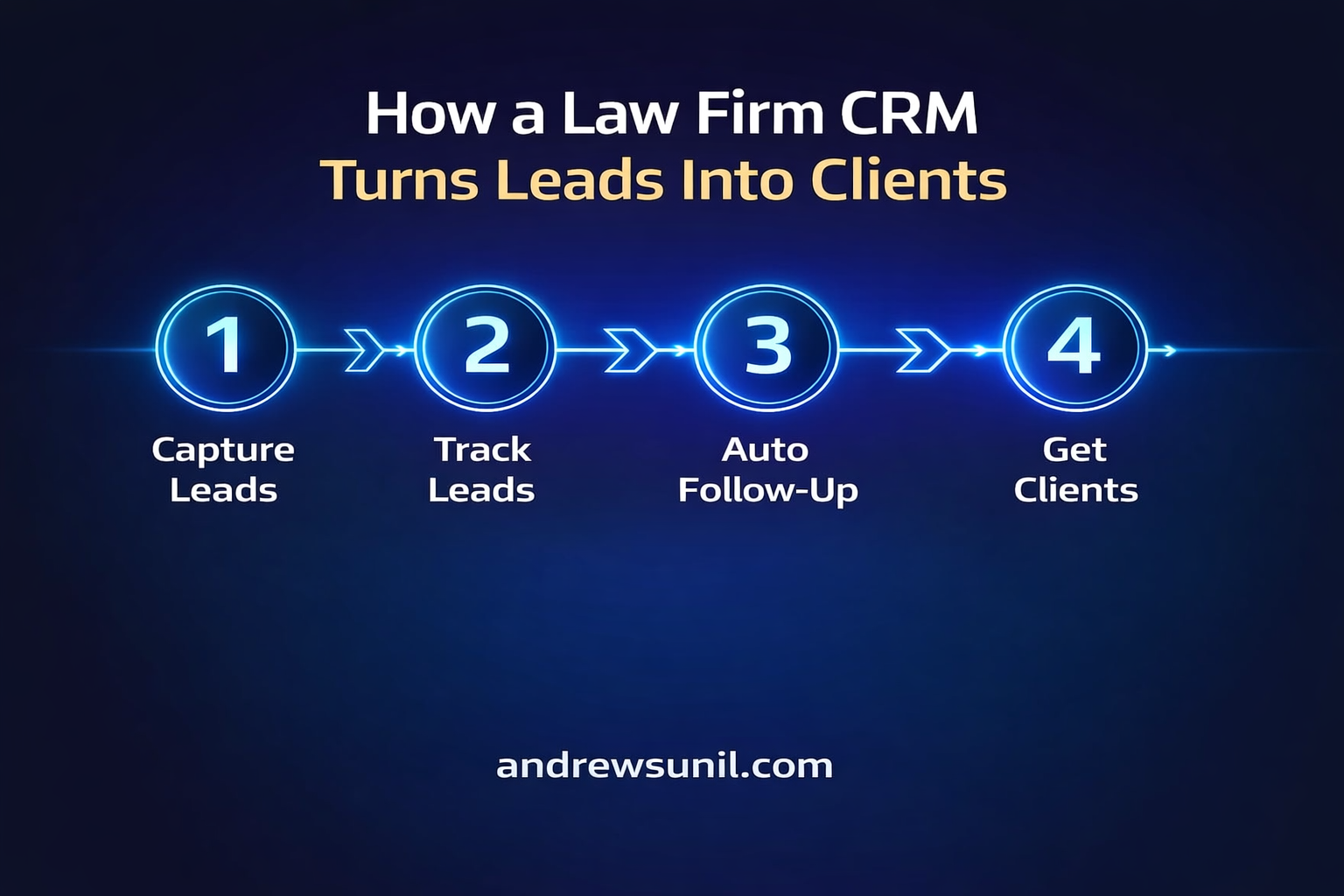
1. No CRM Tracking
This firm didn't have a proper CRM system before we started working with them. That meant:
No record of who called
No visibility into follow-up actions
No way to track pipeline stages
Zero accountability for dropped leads
When there's no system tracking what happens after the phone rings, leads fall through the cracks. Not because anyone is lazy or incompetent—because there's no infrastructure to catch them.
What this means in practice: Without CRM tracking, you're running your law firm like a retail store with no cash register. Money is changing hands, but you have no idea how much or where it went.
2. Poor Speed to Lead
In criminal defense, urgency drives everything. Someone just got arrested. They're scared, emotional, and looking for help right now.
If you don't answer, they're calling the next lawyer in 60 seconds.
The firms that win aren't necessarily the best lawyers. They're the ones who answer the phone first and give the caller a reason to stop searching.
Where most firms go wrong: They treat speed to lead like a nice-to-have instead of a conversion metric. If your average response time is over 5 minutes, you're losing winnable cases.
3. No Follow-Up System
You're not going to catch every call. That's human.
But the difference between firms that convert 15% of leads and firms that convert 40%? Follow-up.
Most firms send a contract and assume the caller will sign. They won't. People need multiple touchpoints before they commit, especially when they're spending $5,000+ on legal representation.
Real example: This firm had 15 leads in the "attorney will call you back" stage. Zero automated follow-up. No SMS reminder. No email check-in. Just silence. And most of those people hired someone else.
4. Intake Trained for Admin, Not Urgency
Front desk staff are great at administrative tasks. Taking messages. Entering information. Scheduling appointments.
But intake isn't admin work. It's sales.
The person answering your phone needs to understand the emotional state of an arrest call, especially when the caller is a spouse, parent, or other relative trying to hire help for someone else.
Our guide on how to convert family-member criminal defense leads explains how to build trust with that caller and move the conversation toward a signed client.
Strategic takeaway: If your intake team views their job as "taking messages," you're losing 30-40% of possible conversions. Their job is to convert callers into signed clients, not to route calls efficiently.
How We Fixed It (And Tripled Their Close Rate)
The fixes we implemented weren't complicated. They were systematic.
Fix #1: Track Everything
We set up a CRM with complete visibility into every lead:
When the lead was added
Time of first contact
All inbound and outbound calls
Pipeline stage tags (newly added, attorney will call back, contract sent, etc.)
But here's the part most firms miss: tracking only works if it's automatic.
The attorneys weren't updating lead statuses after callbacks. Not because they didn't care—they were busy practicing law.
So we gave them tracked phone numbers. When an attorney called a lead back, it automatically logged in the CRM. No additional steps required.
We didn't change behavior. We changed the system.
The approach: Use a firm-tracked number (CallRail, WhatConverts, or CRM dialer) that forwards to the attorney's cell. Every outbound call gets logged automatically. The attorney's workflow stays exactly the same, but now we have visibility.
Revenue impact: This single change eliminated the visibility gap on 15 leads per month that were previously untracked. At even a 30% conversion rate, that's 4-5 additional cases monthly.
What we measured: Percentage of qualified-lead calls with a call record in the CRM. Target: 95%.
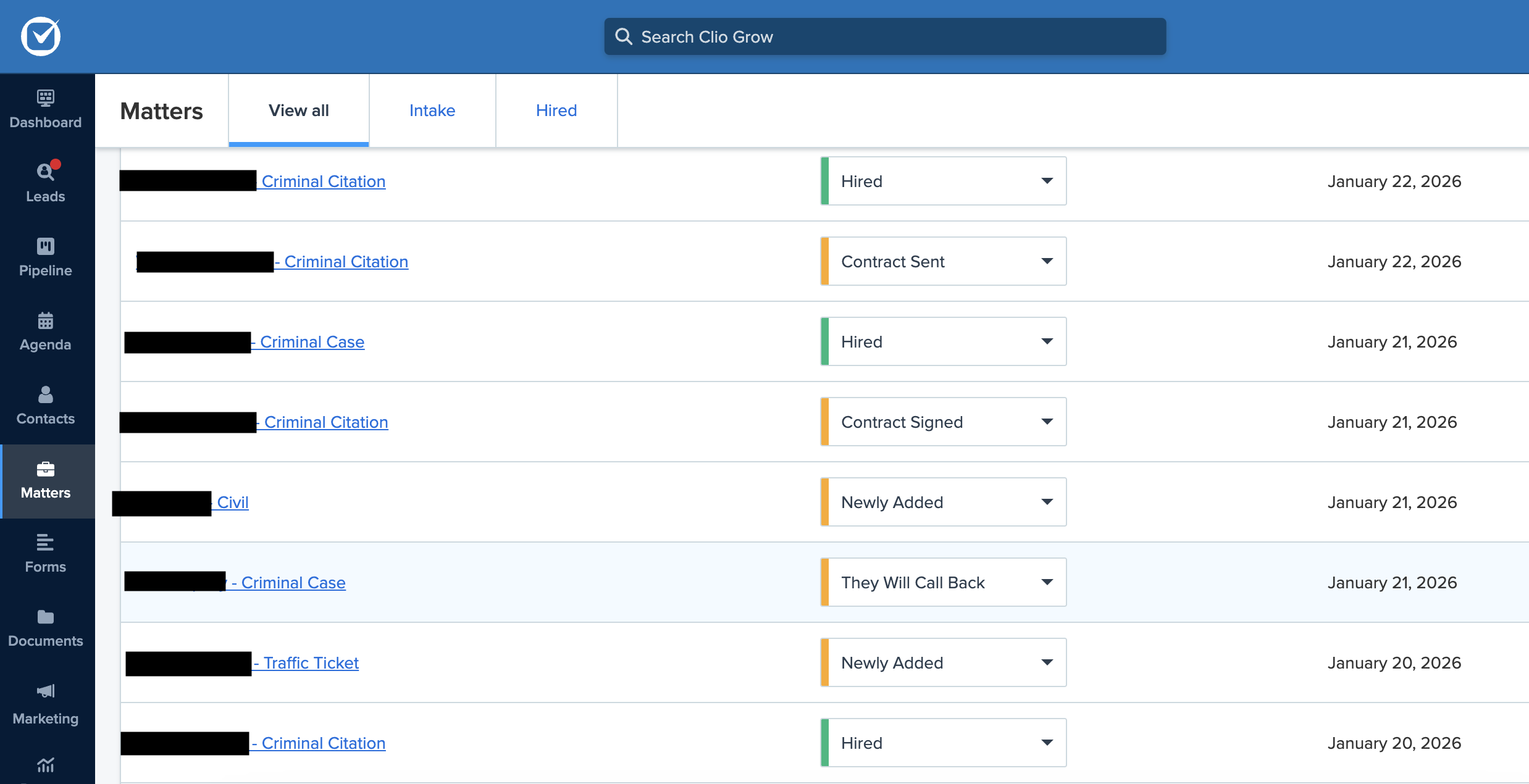
Some of the pipeline stages we setup inside of Clio Grow.
Fix #2: Speed and Acknowledgment
We implemented two rules:
Rule 1: Missed call text-back
If a call goes unanswered, an automatic SMS goes out within 60 seconds: "Sorry we missed your call. We'll call you back shortly."
This acknowledgment keeps you in the game. Silence reads as rejection. Even a simple "we got your call" text maintains engagement while your competitor's phone rings unanswered.
Rule 2: Attorney callback pre-sell
When a lead is marked "attorney will call you back," they immediately receive a text explaining who will call them, when to expect it, and why this attorney is the right choice.
This second fix was critical. The lead attorney was often busy and couldn't call back immediately. That delay—even just a few hours—was killing conversion.
By pre-selling the attorney before the callback happened, more people answered when he called. And when they did answer, the conversation was warmer and closer to a yes.
The message included:
Who would be calling (the lead attorney)
What to expect
Social proof (how he'd helped others in similar situations)
Why he was qualified to help
What this means in practice: Acknowledgment is conversion. People calling criminal defense firms are emotional and urgent. If they don't hear back quickly, they assume you don't want their business.
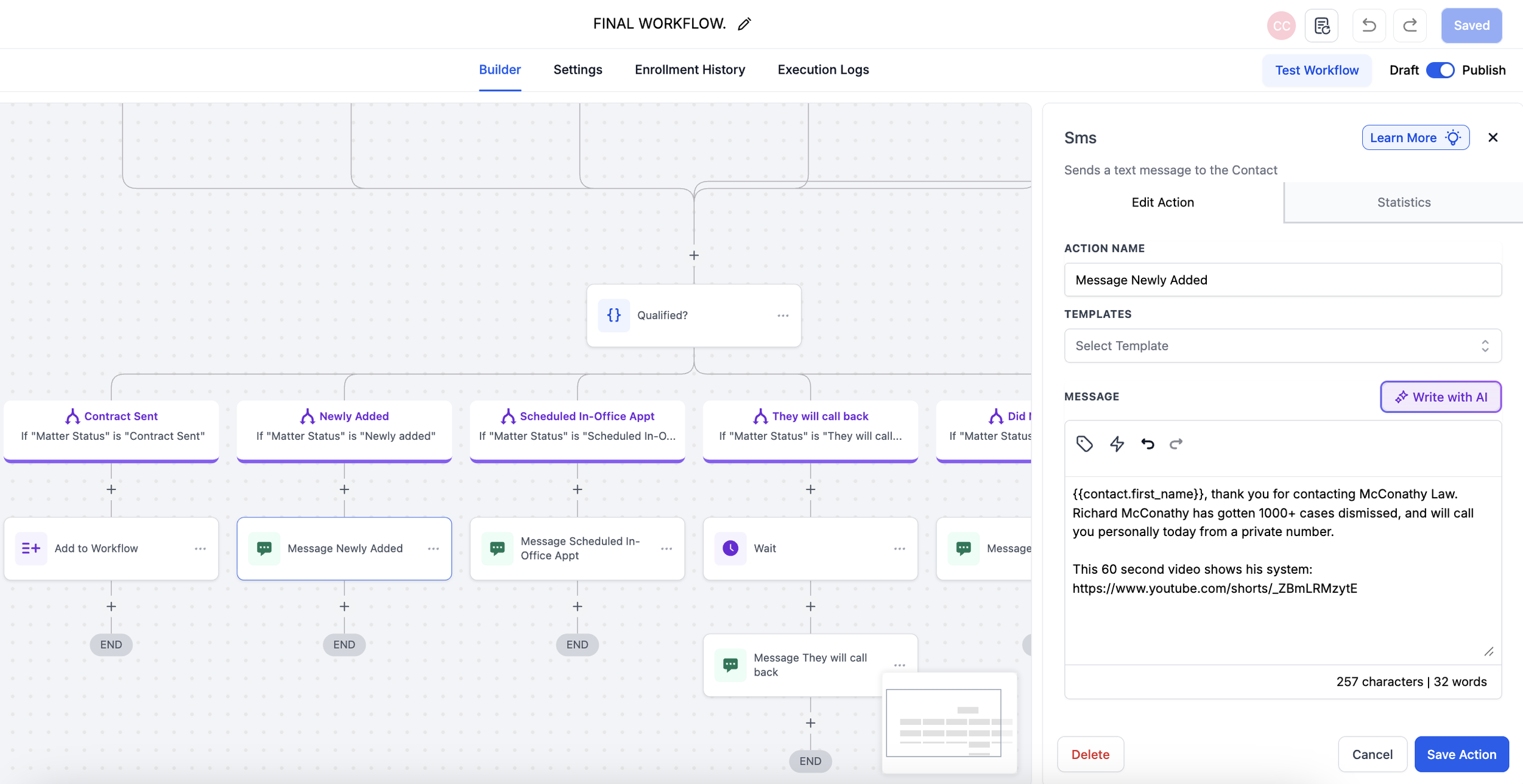
The backend of the automation we setup for missed call text backs,
Fix #3: 30-Second Outcome Updates
Every interaction with a lead—whether it's a call, voicemail, or email—gets a 30-second outcome update in the CRM.
We created a simple dropdown:
Reached / No Answer / VM Left
Promised Callback
Quoted Fee
Rejected / Referred
Contract Sent / Signed
Plus a "Next Step" field with a due date that auto-creates a task.
This eliminated "unknown status" leads. Every lead has a current state and a next action.
Ownership rule: Whoever touched the lead last adds the update. Simple.
What we measured: Percentage of qualified leads entered in CRM within 24 hours (goal: 100%) and percentage with a current outcome (goal: 95%+).
Fix #4: Sign More Contracts
The "contract sent" stage is where most firms leave money on the table.
Think about it: these people know your pricing. They've said yes. They have a contract in their inbox. They just haven't signed yet.
And most firms do... nothing. They send the contract and wait.
We set up automated follow-up sequences:
Day 1: "Here's your contract. Sign it here."
Day 2: "Just checking in. Any questions about the contract?"
Day 3: "We helped [client type] with [similar situation]. We can do the same for you."
Day 4: Personal call from intake team
The automation stops only when the contract is signed.
Real example: Before this system, the firm sent out roughly 10 contracts per week. Only 2-3 came back signed. After implementing follow-up automation, that jumped to 6-7 signed contracts per week—a 200%+ improvement on the same lead volume.
Why this works: People need reminders. They're busy, stressed, and dealing with an arrest. A contract sitting in their inbox isn't a priority until you make it one.
The Results: 30 Cases to 85 Cases Per Month
After implementing these four fixes, signed cases went from approximately 30 per month to over 85.
Same marketing budget. Same ad spend. Same lead sources.
The only difference? A system that stopped leads from leaking out before they ever reached a lawyer.
This is the part most criminal defense firms refuse to accept: more leads don't solve a broken intake system. They just give you more ways to lose money.
Where Most Firms Go Wrong
The intake problem isn't about individual performance. It's about the system.
When we analyze failing intake systems, we see the same pattern:
Firms blame the people. "Our front desk isn't good at sales." "The attorney is too busy to follow up." "Clients don't sign contracts."
But the real issue is infrastructure. You can't rely on human memory and discipline to manage a multi-touch sales process. You need automation, tracking, and accountability built into the workflow.
The shift: Stop asking "Why didn't someone follow up?" Start asking "Why doesn't our system make follow-up automatic?"
What You Should Do Next
If you're a criminal defense firm owner reading this, you need to know where your leaks are.
We'll do a free case leak audit for your firm. Here's what we'll analyze:
Your Last 30 Days of Intake Activity:
How many qualified calls came in
How many were entered into your CRM
How many had documented follow-up
Where leads are stalling in your pipeline
Your Pipeline Gaps:
Leads sitting in "attorney will call back" with no activity
Unsigned contracts with no follow-up
Your average speed to lead on missed calls
Exactly where qualified leads are disappearing
What You'll Get:
A breakdown of your intake conversion rate, where you're losing cases, and how much revenue is sitting in your pipeline right now.
No pitch. No pressure. Just the numbers.
This is only for:
Criminal defense or DUI firms getting at least 30 qualified leads per month
Firms with a CRM (or willing to implement one)
Firm owners ready to fix systems, not just buy more ads
The firms that win in criminal defense aren't the ones spending the most on Google Ads. They're the ones who turn 40% of their leads into clients instead of 12%.
That difference is worth millions.
Frequently Asked Questions
How much does a 55% intake leak actually cost?
For a firm getting 64 qualified leads per month with an average case value of $5,000, a 55% intake leak costs approximately $1.68 million annually. Most firms don't realize this because they're tracking lead volume, not conversion rates through each pipeline stage.
What's a realistic close rate for criminal defense intake?
Most criminal defense firms close 12-15% of qualified leads. Firms with systematized intake close 35-45%. The difference isn't better lawyers or cheaper pricing—it's speed to lead, follow-up systems, and CRM visibility.
How many follow-ups should we send after sending a contract?
Minimum 3-4 touchpoints over 4-5 days. Most firms send the contract and wait—leaving 60-70% unsigned. Automated follow-up can double your contract signature rate on the same lead volume.
