How Smart Criminal Defense Firms Generate 100+ Google Reviews on Autopilot
Most criminal defense firms ask for reviews randomly.
A staff member remembers.
A client seems happy.
Someone sends a text.
That approach produces maybe 2-3 reviews per month. If you're lucky.
Meanwhile, your competitors with 100+ reviews are dominating the maps rankings. And every call you lose to them because you're buried on page two costs you $3,000–$15,000 in revenue.
If you're serious about dominating local search, criminal defense SEO requires more than just reviews—but reviews are where most firms are bleeding opportunities.
For a Texas criminal defense firm, we built a system that has generated 100+ real Google reviews.
Eleven of those came in just 10 days.
This wasn't a gimmick. It was a strategic review capture system tied to case outcomes, automated follow-up, and human touch, with one hidden advantage most firms don't think about.
Watch the video below to see the full system, or continue reading.
The Problem: Random Review Requests Don't Scale
Here's what most firms do wrong.
They rely on memory. Someone on staff is supposed to remember to ask for reviews. But cases close at different times. Staff gets busy. People forget.
They ask at random times. Sometimes right after intake. Sometimes weeks later. Sometimes never.
They send one email and hope.
No follow-up. No system.
Just hope.
The result? You get reviews when you get lucky. Not when you earn them.
And if you're trying to compete in competitive markets like Dallas, Houston, or Austin, luck isn't a strategy.
What Actually Works: Trigger Reviews on Case Resolution
The best time to ask for a review is when you've just won.
Not when the client hired you. Not randomly three weeks later. Right after you've successfully defended them.
That's when they're most grateful. When the outcome is fresh. When they actually want to talk about what you did for them.
So we built the system around one trigger: case closure.
Every time a case is marked closed in the CRM, an automated SMS goes out immediately asking for a review.
No staff memory required. No guessing. No forgetting.
What this means in practice: If your firm closes 20 cases per month, you now have 20 guaranteed review requests going out at the exact moment clients are most likely to respond.
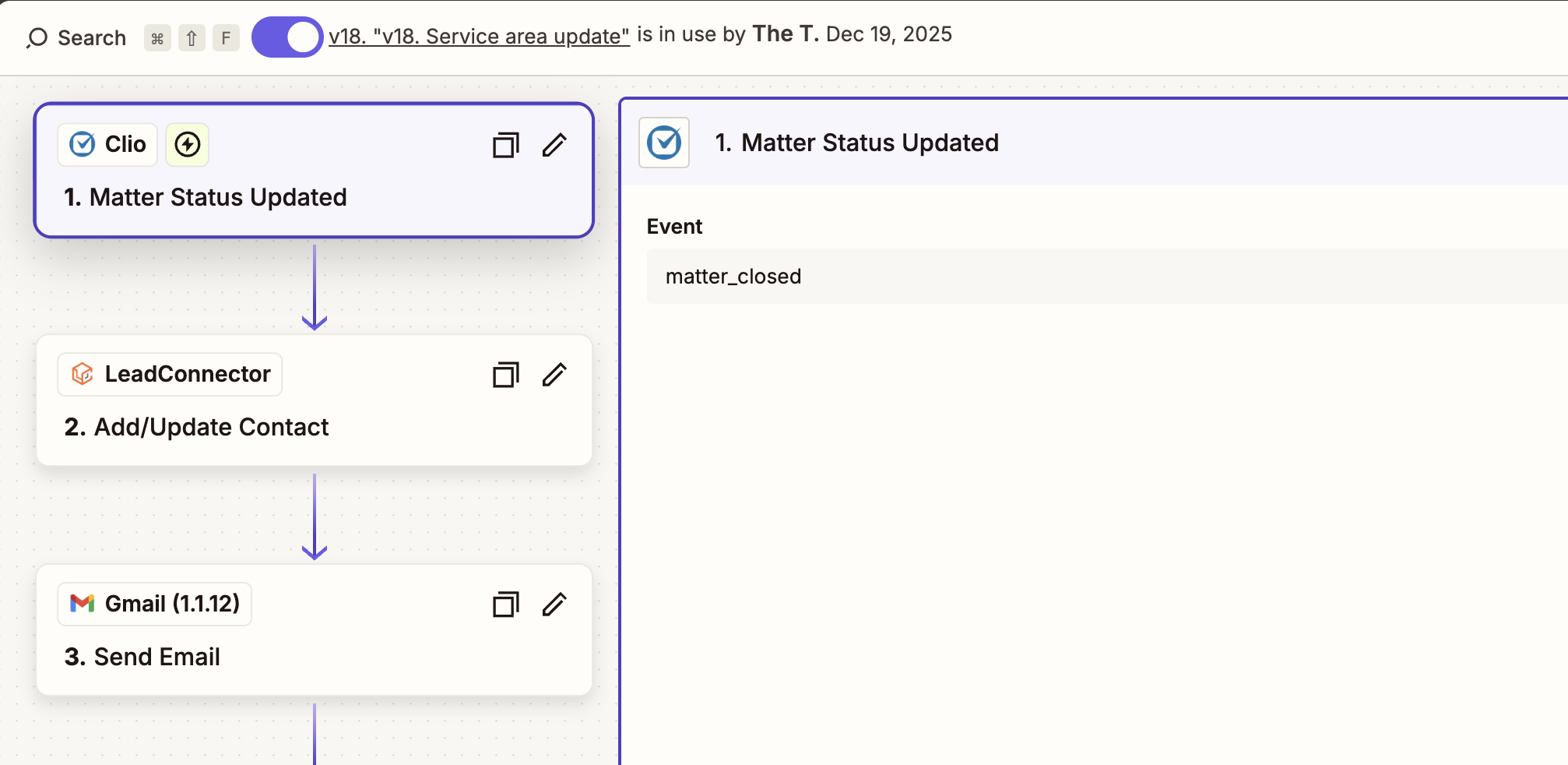
What triggering an automation based on case closure looks like.
The review request goes out as soon as it is marked closed in Clio. You can adapt this to whatever CRM you are using.
Why One Ask Isn't Enough (And What to Do Instead)
Most people don't leave a review on the first ask.
They're busy. They forget. They mean to do it later and never come back to it.
That's why the system includes automated follow-up.
Here's the sequence:
SMS immediately after case closure
Email 2 days later if no review has been left
Second email 3–4 days after that if still no review
This isn't pushy. It's respectful persistence.
The language reinforces the result you got for them. It reminds them why they hired you. It makes it easy to leave the review with a direct link.
Where most firms go wrong: They send one message and give up. They assume if someone doesn't respond immediately, they're not interested. But people are forgetful, not ungrateful. Multiple touchpoints give them multiple opportunities to follow through.
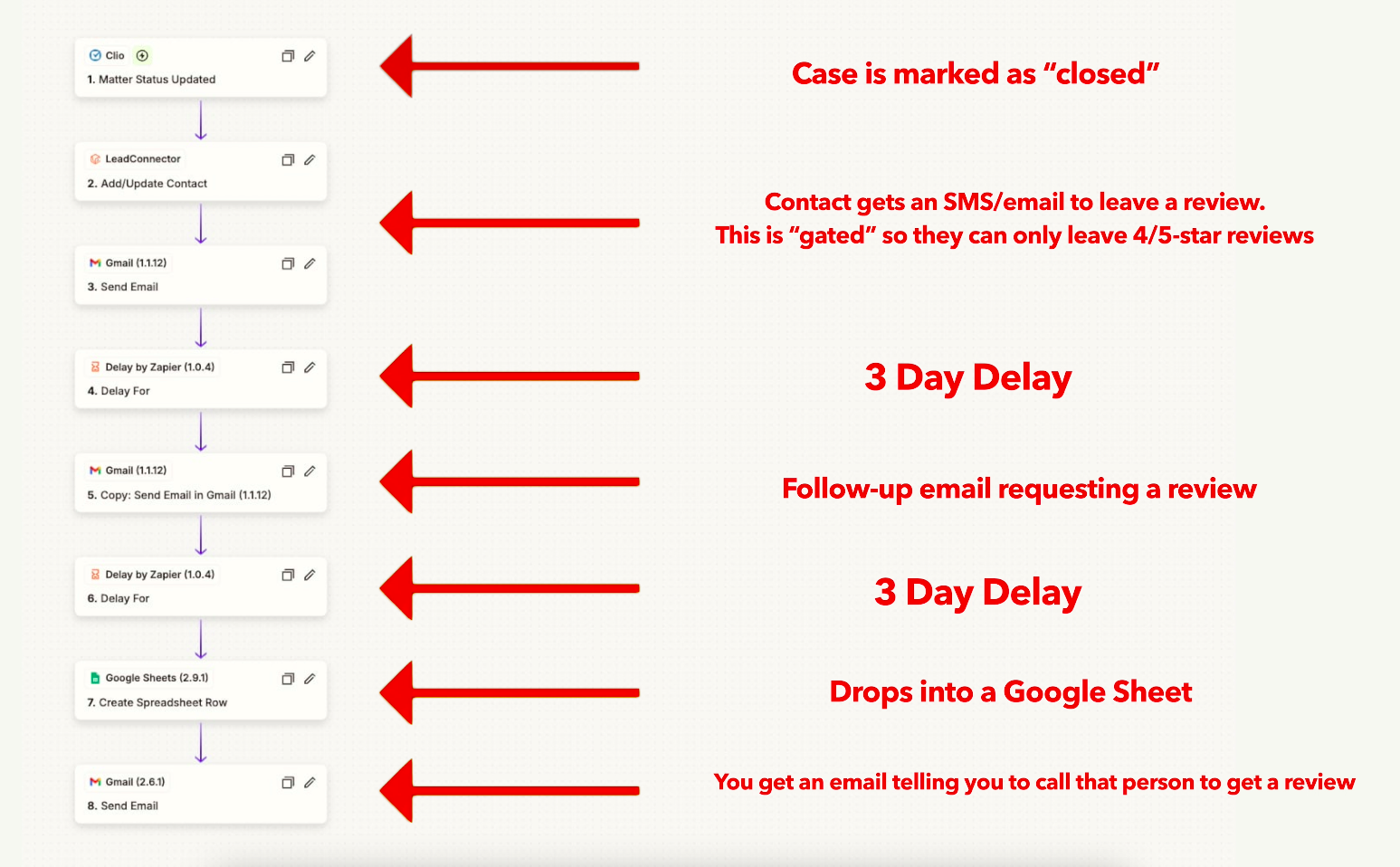
Our Full Review Automation
The Hidden Weapon: Human Follow-Up
Automation handles volume. But human outreach captures the holdouts.
After the automated sequence completes, every person who hasn't left a review drops into a Google Sheet with their contact details, case outcome, and resolution date.
Then a rep calls them.
Not to pressure. Not to guilt trip. To thank them for their business, remind them how the case turned out, and gently ask if they'd be willing to share their experience.
This is where you capture the reviews automation misses.
Here's the real data from the Texas firm's review follow-up tracker:
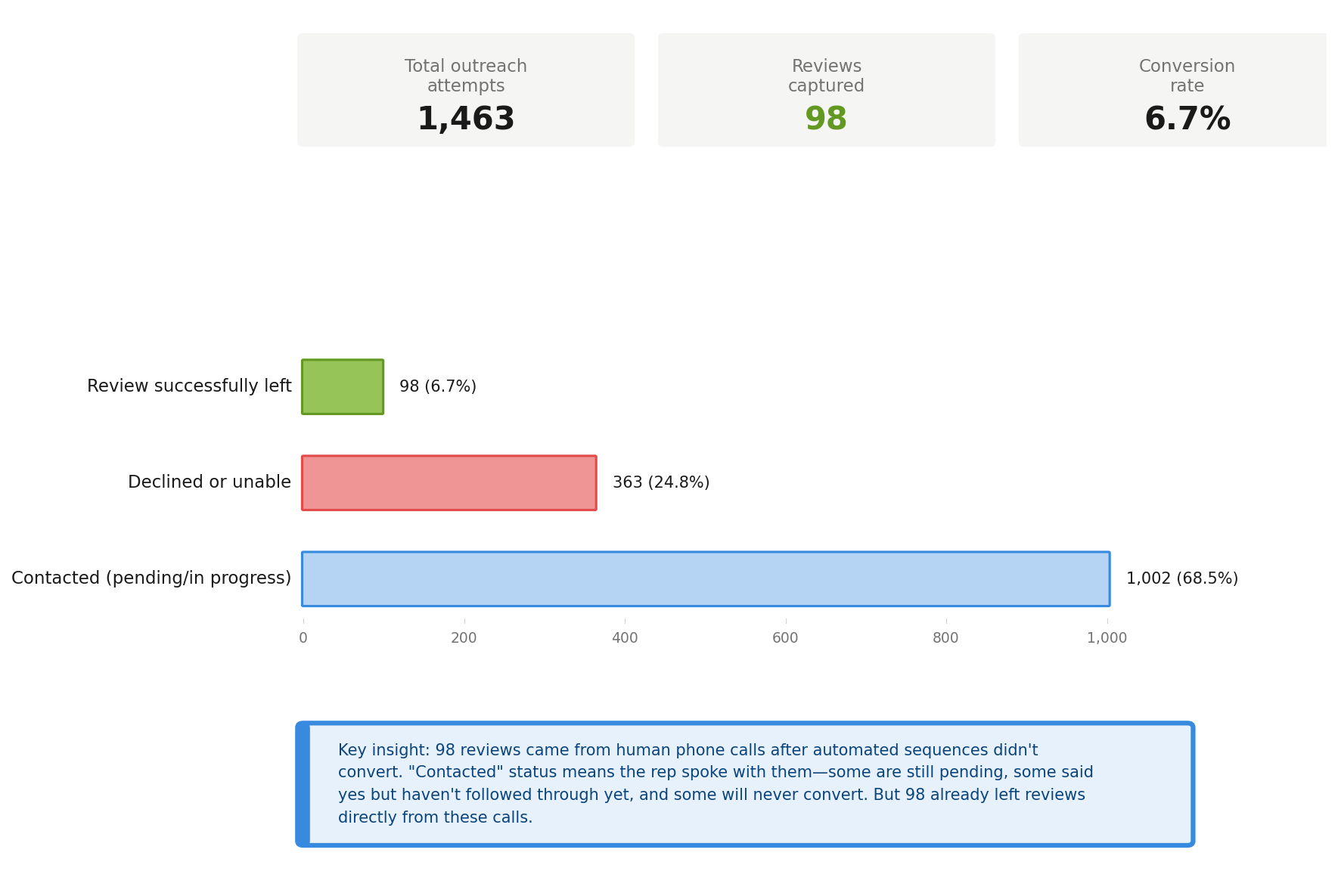
How the review capture data breaks down
Out of 1,463 human outreach attempts, 98 reviews came directly from phone calls—clients who didn't respond to SMS or email but said yes when a real person called them.
That's a 6.7% conversion rate from human touch alone.
What this means in practice: If your automated sequence captures 30% of potential reviews and human calls capture another 7%, you're now at 37% total capture rate. That's the difference between 6 reviews per month and 22 reviews per month if you close 60 cases.
And here's the strategic bonus most firms miss entirely:
If the client already left a review before the call, the rep uses that conversation to remind them of other practice areas the firm handles. DUI client who left a five-star review? Great. Now they know you also handle drug charges, assault cases, and expungements.
The next time they or a friend catch a charge, you're the first firm they think of. Your number is already saved in their phone.
Where most firms go wrong: They hide behind automation because calling feels uncomfortable. But discomfort is where competitive advantage lives. Your competitors aren't making these calls. That's exactly why you should.
The Reputation Firewall Most Firms Don't Use
Not every client is going to leave a five-star review.
Sometimes they're upset about the outcome. Sometimes they didn't understand the process. Sometimes they're just difficult.
That's why we built in a firewall.
When clients click the review link, they're sent to a survey first. They select 1–5 stars.
If they select 4 or 5 stars, they're directed to the Google Business Profile to leave a public review.
If they select 1–3 stars, they're directed to an internal feedback form where they can share concerns privately.
This protects your reputation while still giving unhappy clients a way to be heard.
Important: To stay compliant with Google's terms of service, you need to make it clear that this is what you're doing. Clients who genuinely want to leave a negative public review must have that option. But most people who are frustrated just want to be heard—they're fine leaving internal feedback instead.
The Strategic Advantage: Funneling Reviews Where They Matter Most
Here's the part most firms never think about.
You don't just want reviews. You want reviews in the right locations.
This firm had 15 locations across Texas. Some were competitive (Dallas, Houston). Some were smaller markets (Frisco, Plano).
We didn't send reviews randomly to whatever profile the client lived closest to. We strategically funneled reviews to the locations where they'd have the biggest impact.
Example 1: Early on, Dallas was the priority. We sent reviews there to build a stronger foothold in the most competitive market.
Example 2: Later, we targeted Frisco because it was less competitive. The firm had 10 reviews. Getting 10 more would put them head and shoulders above the competition. That small push led to a top-3 maps position and a significant increase in inbound calls from that location.
What this means in practice: You're not just collecting reviews. You're deploying them like strategic assets. You're identifying competitive gaps and filling them with precision.
Most firms don't have this capability because they don't have a system that reliably generates reviews. They're stuck hoping clients remember to leave feedback wherever they feel like it.
This system gives you control.
The Results: 70 Reviews, Top Maps Positions, More Signed Cases
Because of this review system, the firm secured a top maps position in Frisco and dramatically increased visibility in two other office locations.
But reviews were just part of the equation. This system worked because it was integrated with intake fixes and automation improvements.
Revenue impact: More reviews led to higher maps rankings. Higher rankings led to more qualified calls. More qualified calls—combined with better intake—led to more signed cases.
That's the difference between a tactic and a system.
Ready to Build a Review System That Actually Works?
If you're tired of hoping clients remember to leave reviews, it's time to build a local SEO system that works without you.
This review strategy was part of a wider campaign where we fixed intake, automation, and local visibility for this criminal defense firm.
Want to see the full breakdown of how we increased leads and signed cases?
—> Check out the full Criminal Defense Case Study, where we took him from 30 signed cases per month to over 85.
Or if you want help building a review system (and fixing what's actually broken in your marketing), let's talk.
Click the button below to book a call.
